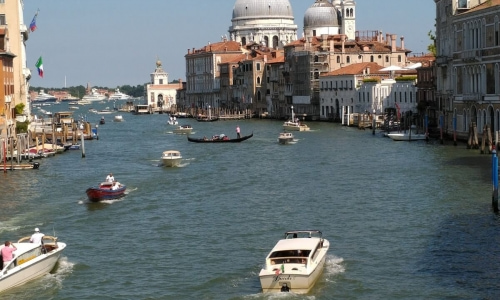

On the Saturday night closest to the third Sunday of July, a pontoon bridge appears across the Giudecca Canal, and half of Venice ends up sitting on a boat underneath it, dinner balanced on the gunwale, waiting for eleven o'clock. This is the Festa del Redentore, and if you only time a Venice trip around one date on the calendar, this is the one locals actually turn out for, not the visitors.
A plague, a vow, and a Palladio church
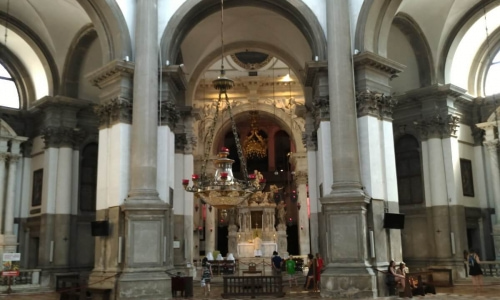
The festival marks the end of the plague of 1575-77, which killed close to a third of the city's population before it finally lifted. The Senate vowed that if Venice was spared, it would build a church in thanks, and commissioned Andrea Palladio to design it on Giudecca, facing the Bacino di San Marco across the water from Piazza San Marco. The result, the Chiesa del Redentore, took fifteen years to finish and is still run by Capuchin friars today. Its white Istrian stone facade and domed silhouette are considered one of Palladio's finest works, ranked by most architectural historians alongside his San Giorgio Maggiore just along the same waterfront. Every year after it was consecrated, the doge crossed to it on foot along a temporary bridge of boats, and that walk is the one part of the festival that has never stopped.
The bridge that only exists for a week
City workers lash the modern pontoon bridge together from the Zattere, on the Dorsoduro side, across to the Giudecca steps in front of the church, usually a few days before the festival weekend and left in place for several days after. It is the only time of year you can walk from Dorsoduro to Giudecca without a boat, and it is worth crossing even outside the main festival hours, when it is just a quiet plank walk over open water with a view down the canal in both directions. Giudecca itself rarely gets much attention beyond the Hilton Molino Stucky, the converted flour mill at its western tip, but it is a genuinely residential island, with the old Fortuny textile works, working boatyards and none of the crowds of the streets across the water.
What happens and when
| When | What's happening |
|---|---|
| Saturday afternoon and evening | Boats decorated with lanterns and balloons anchor along the Giudecca Canal and in the Bacino di San Marco; families eat dinner on board |
| Around 11.30pm Saturday | Half an hour of fireworks launched from a barge near San Giorgio Maggiore, watched from boats, bridges and every fondamenta with a sightline |
| Sunday morning | A procession crosses the votive bridge to Mass at the Redentore; the church stays open to visitors through the day |
Watching it without a boat
You do not need to own or hire a boat to get something out of the night, though it changes the experience considerably. The Zattere waterfront fills early with people who have brought their own folding chairs, wine and a picnic, and by nine there is barely a metre of railing free from the Ponte dell'Accademia end down towards San Basilio. The Riva degli Schiavoni and the Giardini della Biennale side both give a longer, more open view across the water, with less of a crush, if a slightly more distant one. Restaurant terraces with canal views along the Zattere take bookings for the night months in advance, and by June most are already full.
Chartering a spot on a boat for the evening, through one of the small operators around the Zattere or Sant'Elena, typically runs somewhere in the region of fifty to a hundred euros a head depending on the boat and whether dinner is included, which is not cheap but is the closest you will get to how most Venetians actually experience the night.
Getting home again
Vaporetto services get suspended or heavily rerouted for a couple of hours around the fireworks, so check the public transport situation before you rely on the boats to get anywhere near midnight. If you are staying near San Marco, walking back is often faster than waiting for a diverted line 1 or 2 to start running again. Some of the older boat parties do not go home at all; a fading but real tradition has them staying out on the water until dawn, then crossing to the Lido for a swim as the sun comes up, though nobody would blame you for choosing a bed instead.
What people actually eat that night
Roast duck, anatra, is the dish most associated with Redentore, alongside bigoli in salsa, a thick wholewheat pasta with a salty anchovy and onion sauce, both traditionally cooked at home and carried down to the boats in trays wrapped in tea towels. Street stalls along the Zattere sell grilled corn, roasted pumpkin seeds and slices of watermelon, which is less about the food itself than about giving people something to do with their hands for the four hours between arriving and the fireworks starting.
It is a different kind of crowd to Carnevale: fewer costumes and cameras, far more Venetian families who have been doing this on the same stretch of water every July for generations. Nobody is performing for visitors here, which is part of what makes it worth seeing.
- Arrive at the Zattere by 7pm if you want a spot with an actual view of the fireworks, not just the crowd in front of you.
- Bring your own food and drink if you are watching from the fondamenta; nearby bars sell out or close their kitchens early.
- Don't plan on the vaporetto to get you home right after the fireworks; build in a walk or a wait.
- Cross the votive bridge on the Sunday if you missed Saturday night; the church and the walk are worth it on their own.
The fireworks finish, the boats start drifting home in a slow, disorganised convoy with everyone's lanterns still lit, and for a few minutes the whole Bacino di San Marco is more crowded with small lights than the sky above it. The pontoon bridge stays up for another day or two after that, and Giudecca goes back to being the quiet side of the water it is for the rest of the year.