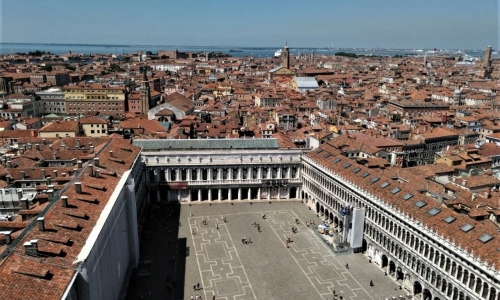

The first thing that hits you is not a costume but a sound — the crackle of a wire overhead and a ripple of applause moving through Piazza San Marco as a figure in a gold cape slides down from the Campanile on a steel cable. That is the Volo dell'Angelo, and it opens Carnevale di Venezia every year: ten to seventeen days of masked balls, fried pastries and a city that briefly stops being a museum piece and remembers it used to throw the best party in Europe.
When it actually happens
Carnevale is a movable feast, tied to the Catholic calendar rather than a fixed date. It runs for roughly the two weeks before Ash Wednesday, finishing on Martedì Grasso (Shrove Tuesday) the day before Lent begins — so the exact dates shift by three or four weeks depending on the year. Check the official Carnevale.venezia.it programme once it is published, usually around November, rather than trusting a blog post with last year's calendar pinned to it.
Whatever the dates, the shape of the festival barely changes. It opens on a Saturday with the Volo dell'Angelo and the Festa Veneziana sull'Acqua, a procession of decorated boats down the Rio di Cannaregio. The middle fortnight is costumes, photography and balls. It closes on Shrove Tuesday with fireworks over the Bacino di San Marco and, historically, a second flying performer — the Volo dell'Aquila — sending off the final weekend.
Free and worth doing
Most of what makes Carnevale worth seeing costs nothing. Piazza San Marco fills every afternoon with people in extraordinary costume standing still for photographers, and nobody minds you joining in with a phone camera. Arrive before ten and you get the square with soft light and thin crowds; by midday it is shoulder to shoulder with tour groups who have come for the spectacle rather than the carnival itself. The narrower campi around San Polo and Santa Margherita are quieter and, honestly, better for photographs — the costumed regulars know it too, and drift there once San Marco gets too crowded to move a wing-span in.
Look out too for smaller neighbourhood events: masked processions along the Riva degli Schiavoni, music in Campo San Giacomo dell'Orio, pop-up performances that never make it onto the official programme. Pick up a paper copy of the schedule from a tourist office; the website misses half of what actually happens on the day.
The balls, if you want to spend properly
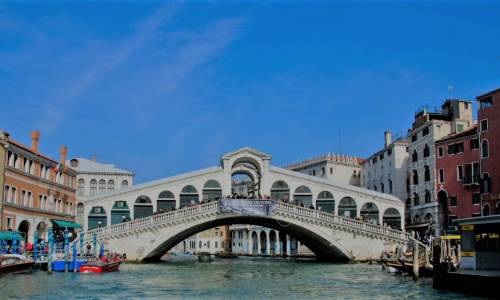
The grand masked balls are where Carnevale gets expensive. The best known, the Ballo del Doge at Palazzo Pisani Moretta, wants a full 18th-century costume and can run to several hundred euros a ticket once you add hire and mask. Smaller balls at other palazzi and at Teatro La Fenice are more affordable and just as atmospheric, with live orchestras and a dress code that is usually gown-or-cape rather than full period dress. Book by December for a February carnival; the good ones sell out, and the costume rental shops around Rialto and San Polo get fully booked in the same fortnight everyone else wants a Bauta and cape.
If a full costume is more than you fancy, a mask on its own does most of the work. A simple papier-mâché piece from a workshop starts around €20–30; a hand-painted or gilded one from a proper Venetian mask-maker runs well into three figures. Either buys you the right to wander the city looking like you belong to it for an afternoon.
Eating your way through it
Carnevale has its own food, and it disappears from bakery windows the moment Lent starts, so eat it while you can. Frittelle veneziane — small fried dough balls, sometimes plain, sometimes filled with custard or zabaione — turn up in every pasticceria from late January. Galani, also called crostoli further inland, are thin ribbons of fried pastry dusted with icing sugar, closer to a crisp than a cake. Neither is fancy. Both are exactly what you want standing in a cold campo at eleven in the morning waiting for the next parade to pass.
| Phase | What's on |
| Opening weekend | Volo dell'Angelo, Festa Veneziana sull'Acqua on the Rio di Cannaregio |
| Middle fortnight | Daily costume gatherings in San Marco, ticketed balls, neighbourhood events |
| Final weekend | Volo dell'Aquila, contests for the best mask, fireworks on Martedì Grasso |
Making it work as a visit
Carnevale is one of the few times Venice is more crowded than August, and hotel prices climb to match, particularly the final weekend. Book accommodation as early as you would for Redentore or the Biennale opening. Vaporetti get packed around San Marco and Rialto during the parades — if you are only there for the crowds, check the timetable before assuming you can just hop on the next boat, because on the busiest afternoons the operator sometimes runs extra services and sometimes simply cannot.
- Book hotels and any grand ball tickets by December for a February carnival
- Arrive at Piazza San Marco before 10am for photographs without the crowds
- Budget €20–30 for a simple mask, far more for a hand-decorated one or a full costume hire
- Try frittelle and galani early — bakeries sell out of the good ones by afternoon
Skip the disposable plastic masks sold from folding tables near the station; they photograph badly and fall apart within a day. A short walk to one of the mask ateliers around San Polo gets you something that actually looks like it belongs to the city, and the people who make them are usually happy to explain the difference between a Bauta and a Volto while you decide. That conversation, more than the fireworks on the final night, is what stays with most people who come for Carnevale once.